Defense Contract Audit Agency Compliance
If your organization performs project-based work for the United States government, you are no doubt aware of the comprehensive audit activities conducted by the Defense Contract Audit Agency (DCAA). In fact, the mere thought of gathering and producing countless records to DCAA auditors is enough to distress even the most experienced federal contractor.
The DCAA, under the authority, direction, and control of the Under Secretary of Defense, performs all contract audits for federal agencies as appropriate. The purpose of these audits is to assure that satisfactory controls are in place to prevent wasteful, careless, inefficient, and fraudulent practices by government contractors. Today, the DCAA employs more than 4,000 auditors and has over 300 Field Audit Offices and sub-offices throughout the United States and overseas.
These complex and time consuming audits encompass the contractor’s entire operation, and only partly include:
- Examining and analyzing accounts, documents, time records, costs, expenses, business practices, and other evidence in accordance with the DCAA Contract Audit Manual, Generally Accepted Government Auditing Standards, the Federal Acquisition Regulation, and other applicable requirements.
- Evaluating the adequacy of internal controls, policies, procedures, and performance;
- Identifying and evaluating activities contributing to, or having an affect on, proposed or incurred costs of federal contracts;
- Reporting suspected fraud or other irregularities to the proper authorities.

The ability to quickly respond to an auditor’s requests with accurate, complete information in a form satisfying DCAA requirements is vital for a successful audit. Consequently, it is imperative for contractors to have strong internal controls, automated timekeeping and activity based costing, explicit billing and cost records, detailed records of transactions for several years, and the processes to produce these records on short notice.
How this Affects Your Organization’s Timekeeping Practices
There are a number of policies and practices that should be implemented at any organization that is subject to DCAA compliance. First, there should be a separation of responsibility between timekeeping for labor-related activities and payroll accounting. Further, the supervisors or project managers who have budget responsibility should not have full control over employee time charges. Rather, employees should be made aware that they are individually responsible for the accuracy of their time charges and the importance of their time card accuracy.


Whether time is recorded manually or through an automated system, it should be recorded on a daily basis with detailed distribution of time to individual project or contract numbers and/or names. Changes made to time, once recorded, should be audited so that it is apparent that a change has been made and by whom. All hours worked should be recorded accurately, regardless of payroll implications of the time (this applies especially to exempt employees who are not compensated for overtime hours). The employee should approve the time at the end of every work period. A best practice is for the employee to review and approve the time record at the end of the day so that the memory of what work was performed in the day is fresh in the worker’s mind. If the employee has a question or disagreement with the time recorded, he/she should have a mechanism by which they can review and correct the time with their supervisor. The supervisor should review and approve all time recorded as well.
How WorkForce Software Can Help You
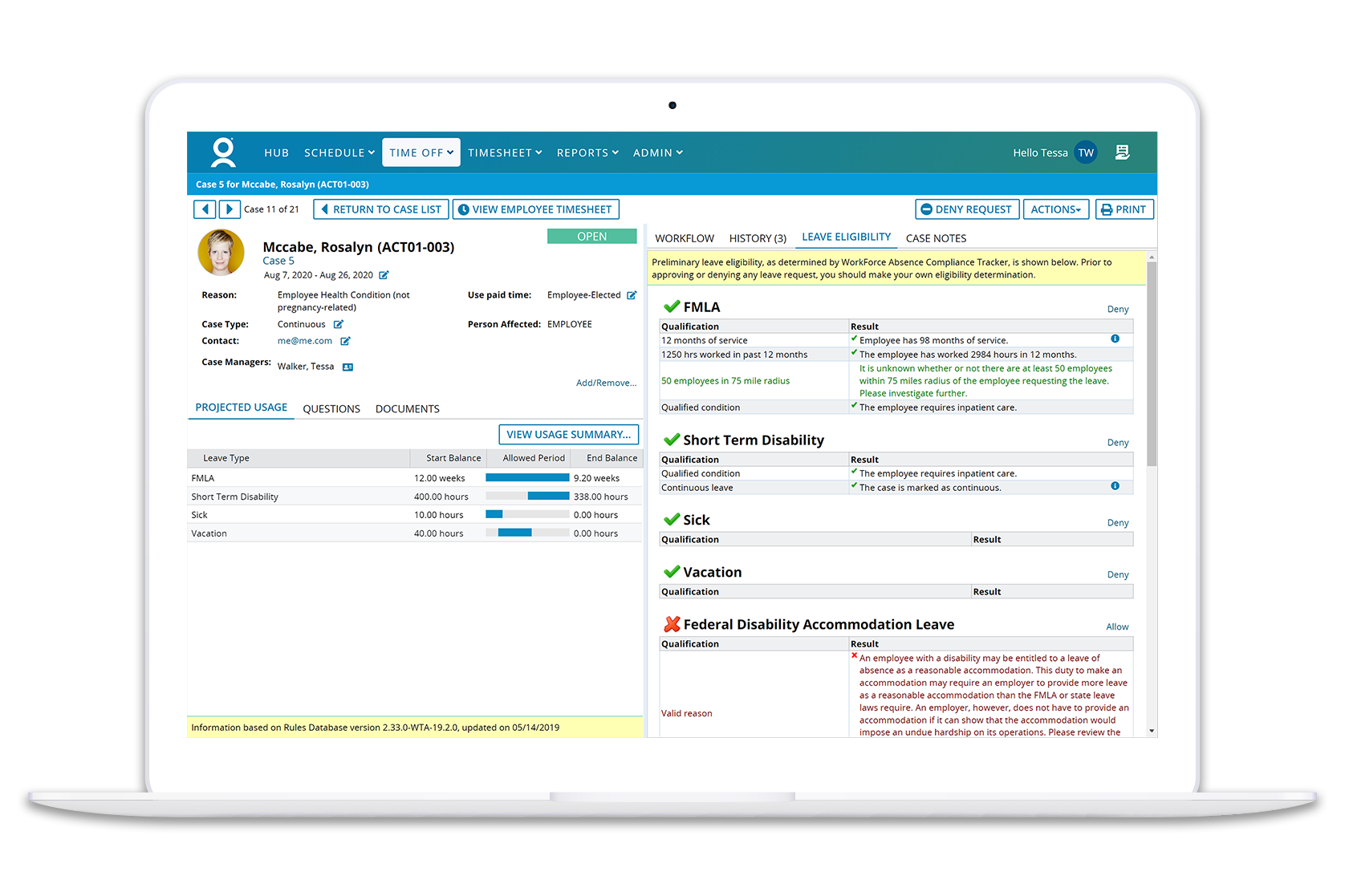
Any DCAA audit involves intensive labor and cost tracking. Over the years, the federal government has established numerous rules and regulations regarding recording work hours and project costs. WorkForce Software can take the worry out of producing a verifiable audit trail by replacing inefficient manual processes with our highly configurable web-based solutions. WorkForce Software’s EmpCenter suite is specifically designed to automate the costly process of capturing time, labor, cost, and other data associated with federal contracts while supplying the detailed supporting documents necessary for DCAA audits and ensuring compliance with the DCAA regulations.
EmpCenter provides appropriate levels of time entry, review and approval by both employees and managers. EmpCenter provides employees the ability to record all work hours on a daily basis (including both direct and indirect hours), even if those hours are not billable. Employee and supervisor access to timesheets is restricted through security. An audit trail documents all changes to a time card, including a sophisticated retroactive correction process to enable prior period corrections. EmpCenter provides numerous reports including a report to highlight missing employee or manager approval of work time.
For many government contractors, the burden of DCAA compliance is overbearing. Often they must hire additional workers merely to help manage the auditing process. In contrast, WorkForce Software’s EmpCenter suite, substantially streamlines DCAA audits, eliminates errors, reduces compliance costs, and gives your company a competitive edge. Standard reports eliminate the need for your organization to manually gather, sort, print, and store massive amounts of paper records. As a result, EmpCenter boosts the efficiency of your workforce management processes, over and beyond helping you stay on the right side of the DCAA.